SMB Local-First Cloud Audit

Stop Cloud Leakage in 15 Minutes.

Zero-Agent. Read-Only. 15-Minute Audit. Find waste fast without touching production.

  1. 0-5 min

    Read-Only Connection

  2. 5-10 min

    Deep Logic Scan

  3. 10-15 min

    Audit Report + One-Click Fix

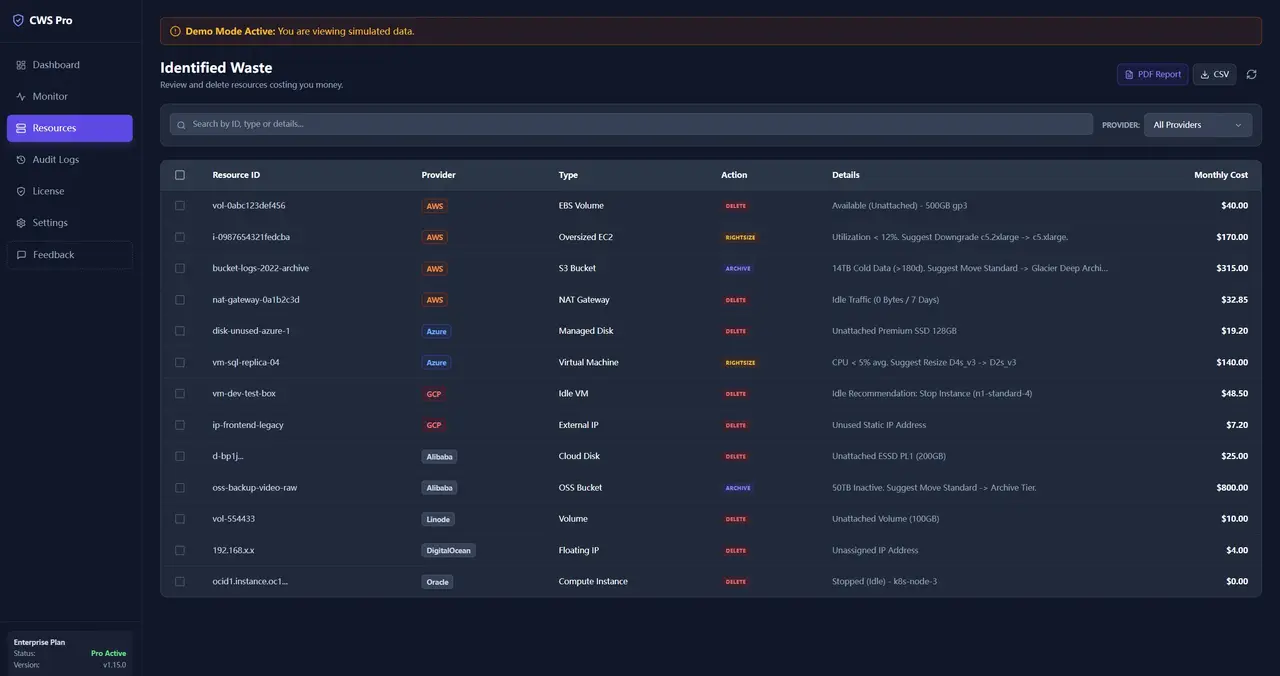
Live product view

Cloud Waste Scanner product dashboard preview
Find Review Share

Built for SMB teams that need savings now, not another dashboard. Run one local audit, surface real leakage, and hand finance a report they can approve.

Most teams recover the monthly fee from one idle resource. Start locally in minutes.

No production changes. No write permissions. 14-day refund path.

If we do not find savings in 15 minutes, your cloud is already a fortress. That result is still useful.

Trust Signal

No Agent Installed

Trust Signal

Read-Only Access

Trust Signal

Works in 15 Minutes

Trust Signal

Used by lean DevOps teams

Need plan details? Open Pricing

SMB first value

What your team gets in the first 15 minutes

No setup maze. Run one local scan and leave with outputs your operator, finance lead, and founder can use immediately.

Output 1

Top waste list with owner context

Know what to stop first, where it lives, and who should handle it.

Output 2

Shareable evidence pack

Dashboard, PDF, and CSV that finance and ops can review from one result set.

Output 3

Report-ready action plan

Turn findings into a reusable report workflow instead of one-off screenshot audits.

Common waste patterns

Start from the three checks teams run every week.

Action-first checks, not abstract governance labels.

Action 1

Find orphaned resources

Catch detached disks, snapshots, and unused IPs that keep charging in the background.

Action 2

Scan unused spend

Surface idle compute and low-utilization resources before the next bill closes.

Action 3

Export fixes in one click

Hand engineering and finance the same report pack without rebuilding context.

What it replaces

A weekly review should replace scramble, not create more of it.

Cloud Waste Scanner is valuable when it removes the recurring manual work around the review, not just the scan itself.

Instead of

Spreadsheet stitching

One report pack replaces the weekly copy-paste pass across billing, resource lists, and screenshots.

Instead of

Console hopping

One review surface replaces the ritual of checking five consoles to explain one cloud bill.

Instead of

Approval rework

One evidence pack replaces the extra slide and summary deck teams usually rebuild for finance and management.

Evidence Preview

A report your operator can run and your CFO can understand.

The sample report is not a marketing mock. It is the same evidence format teams use to move from first scan to ownership, approval, and weekly follow-up.

Module 1

Top findings summary

Prioritized leaks and savings signals help teams align on exposure before details.

Module 2

Owner-ready action list

Findings are mapped to responsible teams so action starts without assignment friction.

Module 3

Finance-ready handoff pack

PDF and CSV outputs carry the same story into review, budgeting, and approval.

Preview of the Cloud Waste Scanner sample report showing findings and savings evidence

Review Outcome

One evidence packet replaces ad-hoc summaries, shortens approval loops, and makes weekly governance repeatable.

Operating view

One scan should answer the buyer questions before a second meeting is needed.

Can it see enough, can it show real leaks, and can the result be handed off cleanly?

Coverage that matters

Enough provider coverage to make the first audit real

47 providers

SMB teams do not need a giant platform rollout first. They need enough coverage to run one serious audit across the clouds and storage platforms they already touch.

AWS
Microsoft Azure
Google Cloud
Alibaba Cloud
Oracle Cloud
Cloudflare
Tencent Cloud
Huawei Cloud
DigitalOcean
Linode
Vultr
IBM Cloud
Hetzner
Backblaze
MinIO
OpenStack

Need the full matrix for internal review? The full provider catalog is still available.

View All 47 Providers

Question 1

Can it show a real leak fast?

Idle compute, storage, and network waste appear in one review surface instead of five consoles.

Question 2

Can the result survive handoff?

Dashboard, PDF, and CSV stay aligned for operator follow-up and finance review.

Question 3

Can we buy without a maze?

Self-serve, refund, and advanced-team paths are already in place when the team is ready.

Operational workflow

A scan is only useful when three teams can act on the same evidence.

Connect one account, run one scan, then move the same output through engineering, finance, and management without rewriting it three times.

Step 1

Connect once

Add one cloud account, validate the route, and keep the credential boundary on your side.

Step 2

Scan with intent

Find idle compute, orphan storage, and unused network resources in one deliberate review pass.

Step 3

Review without rework

Use the same result set for operations, budget review, and executive sign-off.

Trust Boundary

Hosted delivery on one side. Cloud inspection on yours.

Install from us. Scan from your side. Review the same evidence without handing cloud credentials to anyone.

Cloud APIs

Provider endpoints

AWS, Azure, GCP, Alibaba, Tencent, and the rest of your cloud estate.

Privacy Barrier

Operator machine

Local engine + reports

Credentials, scan execution, findings, PDF, CSV, and dashboards stay inside your environment.

Hosted side

Download, licensing, checkout, and docs.

Customer side

Credentials, scans, findings, exports, and local API.

Review result

One evidence pack that security, finance, and operators can all inspect.

Why Teams Stay With It

The workflow still holds when the review loop becomes routine.

The product stays useful because trust boundaries, buying paths, and report handoff remain visible even after the first scan is done.

Security stays clear

The boundary does not disappear after purchase.

Security, privacy, and data-flow pages remain available when internal review expands.

Buying stays simple

Teams can start direct and escalate only when needed.

Self-serve, refund, and advanced-team paths already exist, so buying does not become a separate project.

Reports stay reusable

The same report keeps working across repeat reviews.

Dashboard, PDF, and CSV continue to support operator follow-up and budget review from one result set.

Deployment Lanes

Run Community now, then queue Team or Enterprise rollout.

Community is production-usable and local-first. Team and Enterprise are published with waitlist onboarding while we complete the next delivery wave.

Start with local execution immediately, then move to multi-operator workflow when your internal cadence is ready.

Community

$0 / forever

Production-usable local-first scan workflows for operators who want full source visibility and local execution.

Team

Waitlist

$199 / year

Up to 5 users per workspace. Shared execution rhythm, recurring review support, and team-level operational handoff.

Enterprise

$4,999 / year

Site license lane for organization-level rollout, governance controls, and procurement-ready operating boundaries.

Community is production-usable

Team and Enterprise are waitlist onboarding

No hosted credential custody

FAQ

Three answers buyers usually need first.

What counts as a scan? +
A scan is a fresh run across connected accounts. Opening, filtering, and exporting existing results does not consume additional quota.
Do cloud credentials leave the operator machine? +
No. Cloud Waste Scanner is local-first. Credentials stay on the operator machine and provider API calls run from the customer environment.
Can one result set be shared across teams? +
Yes. Dashboard views, PDF, and CSV are designed to support engineering review, budget review, and management sign-off from the same scan output.

Final step

Start the first audit now, or inspect one real report before you decide.

If the workflow already makes sense, start the 15-minute audit. If you still need proof for a buyer or reviewer, open the sample report first.

No agent, no write path, no cloud key handoff required.